
CELEBRITY
Donald Trump Invents a New Name for the Republican Party as He Continues Teasing Plans to Seek a Third Term in 2028👇👇

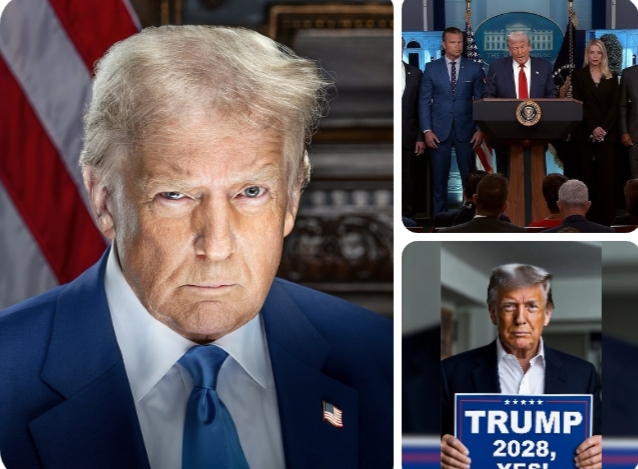
Donald Trump Proposes “TRUMPLICANS” as New Name for Republican Party And Hints at a 2028 Comeback
In late November 2025, former U.S. President Trump rolled out a bold and provocative move: a potential rebranding of his party and a fresh tease of a presidential comeback. On Nov. 29, Trump posted an AI-generated image on his social media platform showing himself holding a sign that read “TRUMP 2028, YES!” and introduced the term “TRUMPLICANS” to redefine what it means to belong to the Republican Party today.
It wasn’t the first time he toyed with renaming the party. Only days earlier, he asked followers on Truth Social whether “TEPUBLICAN” or “TPUBLICAN” might better capture the identity of a “Trump Republican.” But the name he finally settled on TRUMPLICANS signals more than a semantic shift: it reflects a desire to cement his personal brand at the center of the party’s identity.
Yet, the name-change stunt came with a heavier overhang: a renewed hint at a third presidential run in 2028 something the U.S. constitution explicitly bars.
Politically Charged Branding and Why It Matters
Personalizing the party. By attaching his name to the Republican Party effectively merging brand and man Trump attempts to shift the GOP’s identity from a traditional political institution to a vessel for his personal influence and legacy. Many see this as an attempt to transform the party into a de facto “Trump Party.”
Mobilizing supporters. The rebrand and the rally-style “Trump 2028” imagery play into a populist, cult-of-personality style of politics, galvanizing supporters who identify less with traditional Republican ideology and more with Trump himself. This helps keep his base energized and focused.
Signaling dominance. The move implicitly casts those who support Trump as the “real” Republicans drawing a line between loyal “TRUMPLICANS” and any who might dissent. It’s a message of control and ideological ownership.
The 2028 Tease Theatre, Strategy, or Serious Intent?
Despite his playful rebranding, the notion of Trump pursuing a third term is constitutionally barred. The Twenty‑Second Amendment explicitly limits the presidency to two elected terms.
Still, Trump has repeatedly flirted with the idea. In March 2025, in an interview with NBC News, he said many people wanted him to run again though he was careful to call 2028 “a long way to go.”
His recent post shows him holding up the “TRUMP 2028” sign, reviving speculation. To critics and legal scholars, this isn’t serious campaign planning, but provocative political theater: a way to dominate headlines, energize his supporters, and shape the narrative without actually committing to an unconstitutional run.
Reactions Alarm, Ridicule, and Political Fallout
Unsurprisingly, the move sparked a mix of reactions:
Critics labeled it irresponsible, arguing that even entertaining the idea of a third term and re-naming a major political party after one individual undermines democratic norms and institutional integrity.
Many supporters and loyalists shrugged it off as rhetorical flourish or humorous marketing calling it “branding” rather than a serious constitutional challenge.
For political analysts, this appears to be part of a broader strategy: keep Trump at the center of conversation, maintain his dominance over the GOP base, and shape the 2028 political landscape whether or not he himself runs.
What This Means for the GOP & U.S. Politics in 2025–2028
By reframing the Republican Party as “TRUMPLICANS,” Trump is seeking to rewrite the party’s identity from a historically broad coalition of Republicans to a movement defined around him personally. That’s a signal that the future of the party may be less about ideology and more about loyalty, personality, and brand allegiance.
The 2028 tease though almost certainly symbolic also keeps alive uncertainty. It complicates the path for other potential GOP leaders and may drive internal tensions among Republicans who favor more traditional governance over personality-driven politics.
In short: this isn’t just political theater it may be the early shape of a long-term legacy campaign.

ABSOLUTE SHOCKER: Taylor Swift and kindly write me an article about Travis Kelce DROP BOMBSHELL ANNOUNCEMENT—Fans Left Speechless as Power Couple Unleash News NO ONE Saw Coming..Full story below👇👇👇

BREAKING: U.S. First Lady Melania Trump Has Just Tragically Passed Away at the White House — Her Husband Donald Trump Just Jetted Down to Confirm The Devastating News… Read More 👇👇

HOT NEWS: Travis Kelce gifted Taylor Swift with a $8 million Harry Winston diamond necklace for Christmas, a limited edition custom-made for Taylor with a total of 120 carats of diamonds and three rare gemstones READ THE FULL STORY HERE

BREAKING: Taylor Swift Confirms She’s Expecting Twins With Fiancé Travis Kelce — Fans Erupt Over Surprise Gender Reveal

Donald Trump Invents a New Name for the Republican Party as He Continues Teasing Plans to Seek a Third Term in 2028👇👇

“WEEKS TO LIVE?” Elon Musk’s Alleged Final Message to Humanity Sparks Global Shockwave

Travis Kelce Criticizes Donald Trump’s Veterans Day Speech After He Claimed “We Have a 92% Approval Rating — We Took That Up From 38% Under the Previous Administration,” Turning What Should Have Been a Tribute Into Another Campaign Show About Himself. Details below 👇

ABSOLUTE SHOCKER: Taylor Swift and kindly write me an article about Travis Kelce DROP BOMBSHELL ANNOUNCEMENT—Fans Left Speechless as Power Couple Unleash News NO ONE Saw Coming..Full story below👇👇👇

Donald Trump Confuses Dementia Screening for ‘Very Hard’ IQ Test as He Brags About Results…Hot 🔥 👇👇
